
The 4Cs of Content: How to Plan 90 Days of Content in One Sitting
Here's how you plan 90 days of content in one sitting: decide what job each post has to do before you write a word. The 4Cs of Content System™ is a content strategy framework that gives every post one of 4 jobs: Connection, Credibility, Change, or Conversion. Fill 36 slots, three a week for 12 weeks, and chile, you're set until next quarter.
Let me save you from one of the most annoying questions in business:
“What should I post?”
If you're asking that question every time you sit down to create content, you're making content WAY harder than it needs to be.
Here's how you plan 90 days of content in one sitting.
Decide what job each piece of content needs to do before you start creating it. If your actively building a personal brand, every piece of content you create should have one of four jobs:
Build CONNECTION
Establish CREDIBILITY
Evoke CHANGE
Drive CONVERSION
That's the 4Cs of Content System™.
Give each post a main job, create 6 pieces of content per category and boom, you'll have 36 content slots. If you're posting 3X a week, you've got an entire quarter of content planned.
And yes, I've seen this work in a real business. Let me show you that first. Then I'll show you how this breaks down even further and how to do it for yourself.
Does planning your content ahead actually work?
Yep.
My client, Latricia is a Certified Household Manager and Career Coach who helps household managers and hospitality professionals land higher-paying roles.
She knew her audience, she was confident in her expertise, she he knew exactly how she helped her people.
But her content was another story.
It didn't really sound like her, and on top of that, her leads were inconsistent. Some months the inquiries came rolling in. Other months, it was crickets.

So she hired me to take the content piece off her plate.
We refined her brand identity, then I built a 90-day visibility campaign with 36 pieces of content. Every single post had one of the four jobs from the 4Cs.
Over 90 days, she gained:
500 new LinkedIn connections
A 1,000% increase in engagement
A 20% increase in revenue
A steady stream of inbound inquiries from qualified leads
And here's what she had to say:
“Engagement skyrocketed...my follower count grew by 8%, and I gained more than 30 potential clients.”
We gave her expertise a strategy and made sure her content actually sounded like her.
Read more about her story here.
So why does “What should I post?” keep you stuck?
Because it's a broad ass question and your brain has no idea where to start.
You know what I mean.
You know last Sunday night, when you opened your laptop and just stared at LinkedIn.
Maybe you typed something generic like:
“Happy Monday, y'all!”
Then immediately deleted it because...girl. No.
Then you started scrolling through everybody else's content looking for inspiration.
Chile, 30 minutes later, you done saved 3 posts, watched a million reels, questioned your entire life and still aint posted a damn thing.

Then the gurus tell you: “You just need to post more!”
So you try to “just show up” as they say, but by week 2, you're exhausted, your content is all over the place, and you still don't know what the hell you're supposed to say.
It's because you left it wiiiide open.
Harvard Business Review has written about this. Research across 145 studies found that constraints can actually help people become more creative. When you have some boundaries to work within, your brain has something to work against instead of staring at an endless field of possibilities.
Which makes sense.
“Tell me something interesting about your business” is hard.
“Give me 3 things your audience gets wrong about this” is MUCH easier.
The 4Cs of Content System™ gives your content a focus.
What is the 4Cs of Content System™?
Every piece of content you publish should be doing one of 4 jobs.
Build Connection: Make people feel like they know you.
Establish Credibility: Show them you know what you're talking about.
Evoke Change: Shift the way they think.
Drive Conversion: Give them a reason to work with you.
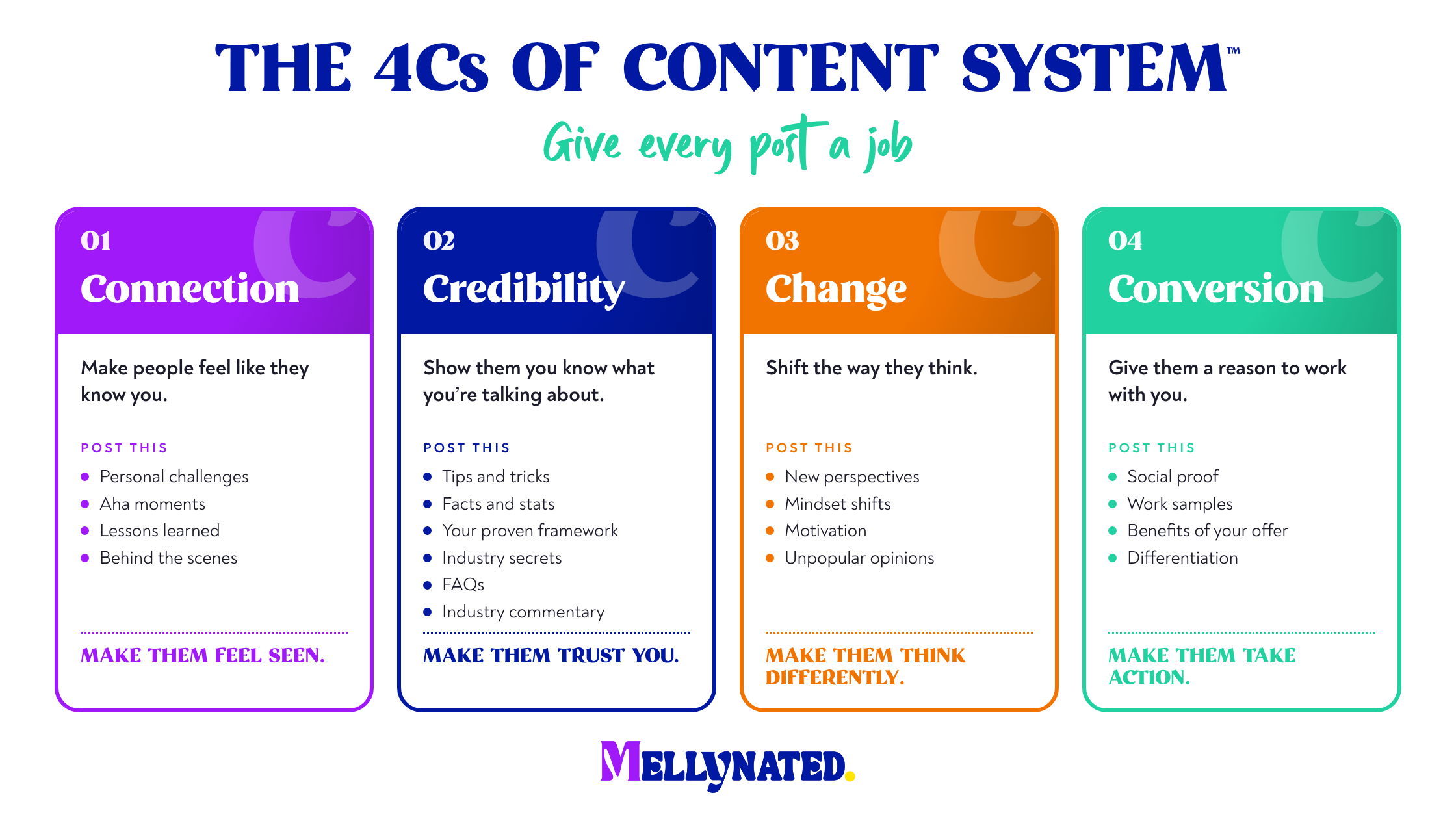
Now here's the thing, you need balance, right? Not every post necessarily needs to sell, they actually shouldn’t. But if NONE of your posts sell, Houston, we have a problem.
Not every post needs to teach. But if every post is a damn tutorial, Houston, we have another problem.
Your content needs balance, that's why the 4Cs work so well.
Let's break them down.
Connection: Make Them Feel Like They Know You
Connection content gives people a reason to care about you, not just the information you know.
This is where your personality, experiences, stories and perspective come into play.
Think about:
Personal challenges: Something you struggled with that your audience is struggling with right now.
Aha moments: A realization that changed the way you think or operate.
Lessons learned: Something you got wrong and what it taught you.
Behind the scenes: The messy real-life process behind the result.
Here's a simple test; if somebody read 5 of your posts and still couldn't tell you anything about you as a person, you're probably starving your Connection content.
And no, I'm not saying you need to tell the internet your deepest, darkest secrets. We not doing that.
I'm saying people need something to connect to.
Because information gets consumed, but stories stick. I've written more about why your stories are some of your strongest marketing here.
Credibility: Prove You Know Your Stuff
Your audience needs evidence that you know what you're talking about.
Credibility content can include:
Tips and tricks: Practical things your audience can use right now.
Facts and stats: Data that supports your perspective.
Your proven framework: Teach people how you approach the problem differently.
Industry secrets: Things people inside your industry know that your audience may not.
FAQs: Questions you answer over and over again on discovery calls.
Industry commentary: Your take on what's happening in your industry right now.
And that last one is lowkey one of my favorites.
Use this if somebody releases a new book that's controversial, or someone makes a bold claim that you disagree with, or a trend is taking over your feed.
If you're doing the work, you should have an opinion...share it. This is great strategy for positioning yourself as a thought leader.
Your expertise is not just your credentials and degrees, it's about how you see things. Your unique perspective is part of what makes your personal brand yours.
Change: Shift How They Think
This is the one I see people skip the most, but it’s probably the one that can make you the most memorable.
Change content challenges the way your audience currently sees a problem. Think:
New perspectives: A different way of looking at a problem.
Mindset shifts: The belief that's keeping them stuck.
Motivation: Why doing the hard thing is actually worth it.
Unpopular opinions: Something you believe that your industry isn't saying out loud.
Anybody can give somebody a list of 5 tips, but your perspective is harder to copy.
Change content is where your point of view gets to come out and play.
It's the difference between:
“Here are 5 ways to improve your LinkedIn profile.”
and:
“Your LinkedIn profile is a 24/7 sales page, here are 5 fixes to make it sell."
See the difference? One teaches something Google-able and the other makes somebody stop scrolling and pay attention.
Conversion: Make them Take Action
And now we get to the one that makes everybody uncomfortable…selling.
We’re all comfortable posting tips, motivational quotes and vulnerable stories; but the second it's time to tell somebody how they can actually work with us, all of a sudden we get real shy.
Conversion content can include:
Social proof: Client results, testimonials and transformations.
Work samples: Show the actual work you've done. Before-and-afters are especially helpful here.
Benefits of your offer: What actually changes for somebody when they hire you?
Differentiation: Why does your approach work when what they've already tried hasn't?
This is where your hard core receipts come out. If you've helped somebody get a result, tell us.
If a client said something amazing about working with you, share it.
If your process is different, explain how.
You don't need to be shy about the fact that you have something people can buy.
Research from Northwestern's Spiegel Research Center found that products with 5 reviews were substantially more likely to be purchased than products with no reviews, with reviews having an even stronger effect for higher-priced purchases.
So yes girl…post the damn testimonial.
Your Conversion content should be helping your audience connect the dots between:
“I have this problem” and “This person can help me solve it.”
That's how you get your brand doing some of the selling before you ever get on the call. I talked more about that here.
So How Do You Plan 90 Days of Content in One Sitting?
Now for the part you actually came here for.
If you want to plan 90 days of content without sacrificing your entire weekend, you need 4 things:
A doable cadence.
The 4Cs.
A posting sequence.
A structured way to turn those ideas into actual content.
Give yourself about two hours and work through these four steps.
1. Pick a rhythm you can actually maintain.
Three posts a week for 12 weeks gives you 36 pieces of content. That's the exact volume I used for Latricia's 90-day campaign.
And for a lot of business owners, it's enough. You may not be able to post seven times a day. If you can, more power to you. But you need a publishing schedule you can actually stick to.
Be consistent is plastered everywhere on the internet because it's true.
Research from Buffer found higher engagement among accounts that posted consistently over time compared with those posting sporadically.
So pick a cadence that works with your actual life and business, not some influencer's content calendar.
2. Brainstorm one C at a time.
Don't try to come up with one Connection post, one Credibility post, one Change post and one Conversion post every single week while simultaneously trying to run your business.
Your brain finna start smoking.
Instead, take it one C at a time.
Let's say one of your content pillars is Leadership. Start with Connection with leadership as your main topic.
Write down every personal challenge, aha moment, lesson, behind-the-scenes story related to leadership. Dig a little deeper here and think about how your stories relate back to your audience's current situation. That's the sweet spot to building a real connection.
Then move on to Credibility, then Change, then Conversion.
Stay in one lane until you've emptied the tank.
You'll be surprised how many ideas come out when you stop asking yourself to switch gears every 5 minutes.
3. Turn those ideas into a 90-day sequence.
Alright, this is where you think about your audience's journey.
A good sequence walks people from "who is she?" to "how do I hire her?"
The easiest way to do that is month by month, with a little round robin built in. So, each month gets a focus C.
For example, Month 1, focus on Connection. Let new people get to know you. Tell stories, share experiences, show them how you think and what you care about.
BONUS TIP FOR MY OVER ACHIEVERS:
You can always add a small CTA as a P.S. at the end of these posts in case someone is interested in working with you. So, after a Connection post, you can say something like: "P.S. I'm Sasha Fierce and I help low-income earners raise their credit score by 150+ points. Book a call to learn how I can help you reach a 750 score."
Month 2: Credibility. Now show them what you know. Teach, explain, walk them through your framework.
Month 3: Change and Conversion. Challenge their thinking and connect the dots between their problem and your offer. Each week gets 3 posts. Two go to that month's focus. The third one rotates through the other Cs, round robin style.
That rotating slot keeps all four Cs in your feed all quarter, so you never go a whole month without making an ask. And if your audience already knows, likes, and trusts you? Cut Months 1 and 2 down to two weeks each and give Change and Conversion the extra time.
Here's an example of how that could play out:
Want this as a calendar you can actually fill in?
Grab the free 4Cs 90-Day Content Calendar. All 36 slots come pre-filled with the C and the content type, plus a prompt for every single post so you're never staring at an empty box. Add your dates and platforms, track what's posted, and your whole quarter is handled.

Get the Free 90-Day Content Calendar →
4. Turn Each Idea Into Content With SWERVE™
Now you have your ideas, posting schedule, and your game plan. Now you're probably thinking, “OK...but how the hell do I turn this into an actual post?”
That's where my SWERVE™ storytelling framework comes in.
SWERVE stands for:
Stir the Pot
WTF Moment
Epiphany
Reframe
Validate
Empower
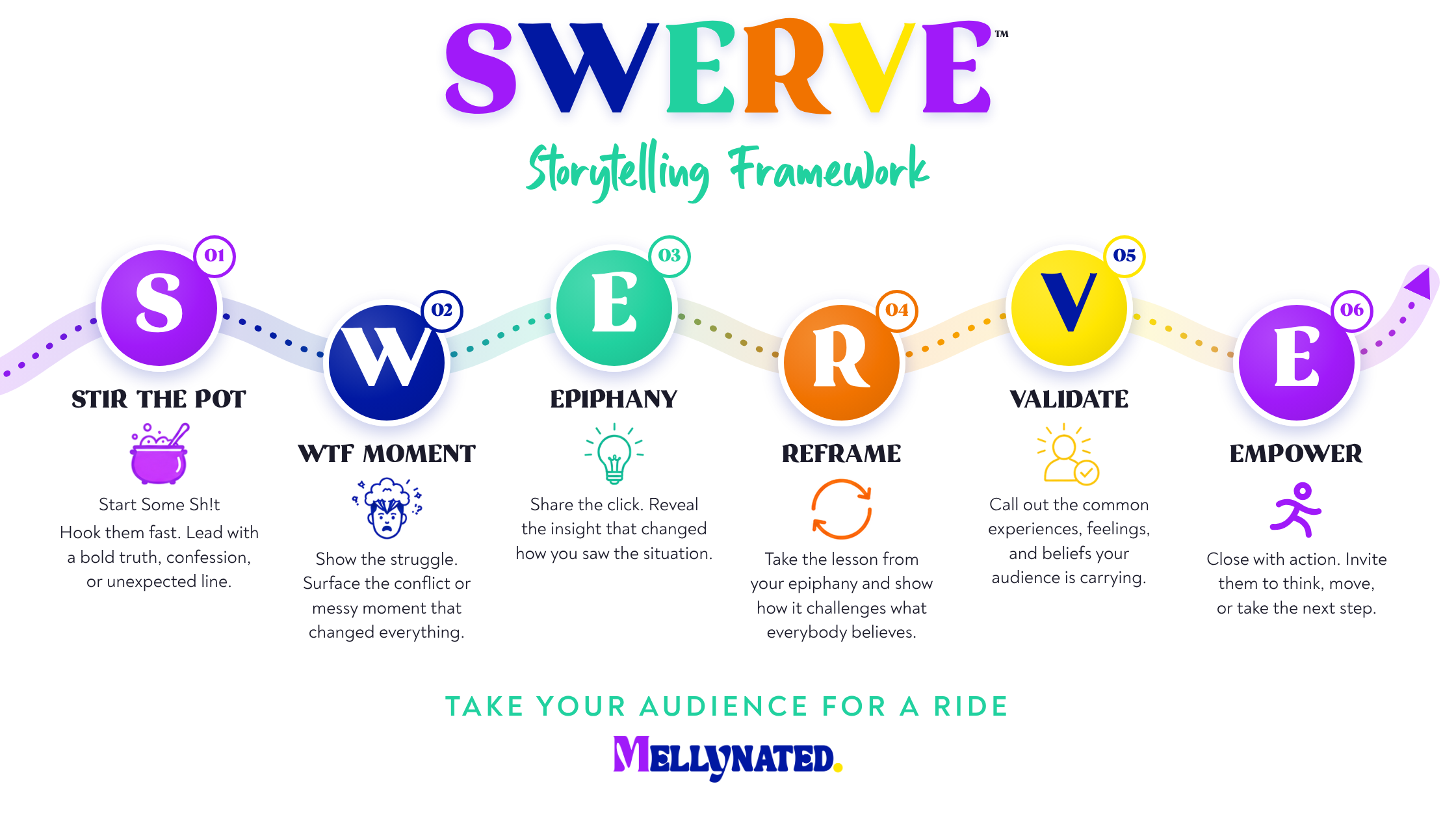
This is how you'll structure your posts when you're telling a story. Use it to take the ideas you've already brainstormed and turn them into stories and posts that actually sound like you.
I break down SWERVE™ in detail here.
Once you know what you're talking about, creating the individual posts becomes MUCH easier.
You're not starting from a blank screen anymore.
But What If You Don't Have 90 Days of Ideas?
Boo. You do. They're just scattered everywhere.
They're in:
Your camera roll
Your inbox
Your last five discovery calls
Your client conversations
Your voice memos
Your notes app
That thing you said in a conversation last Tuesday that had everybody going, “OMG, YES.”
The problem isn't that you have nothing to say. You've never stopped long enough to collect yourself and organize what you've already said into a content strategy.
And here's another thing, one content idea does not equal one piece of content.
That same idea can become:
A LinkedIn post
A carousel
A Reel
A talking-head video
A YouTube video
A podcast episode
An email
A newsletter
A blog post
So when I say 36 pieces of content, I'm not saying you need to come up with 36 completely different thoughts. You can take one strong idea and build an entire content ecosystem around it.
And we're not even done. You also do this process for each of your content pillars.
Let's say you're an accountant and you have 3 content pillars (Tax, Bookkeeping, and FinTech).
You can run the 4Cs across each pillar.
Connection around Tax
Credibility around Tax
Change around Tax
Conversion around Tax
Then do it again for Bookkeeping
Then FinTech
You see where I'm going with this?
You have way more content than you think. You just need a system for pulling it out.
Want Help Building Your 90-Day Content Plan?
You absolutely can do this yourself. Everything you need is right here. But if you're sitting there thinking, "Mel...I do NOT want to spend two hours figuring all this shit out by myself.”
My Content Strategy Session will help you organize this and put together a content plan for the next 90 days and beyond.
In 90 minutes, we pull your actual stories, expertise and ideas out of your head, map them across the 4Cs, and build your quarter together.
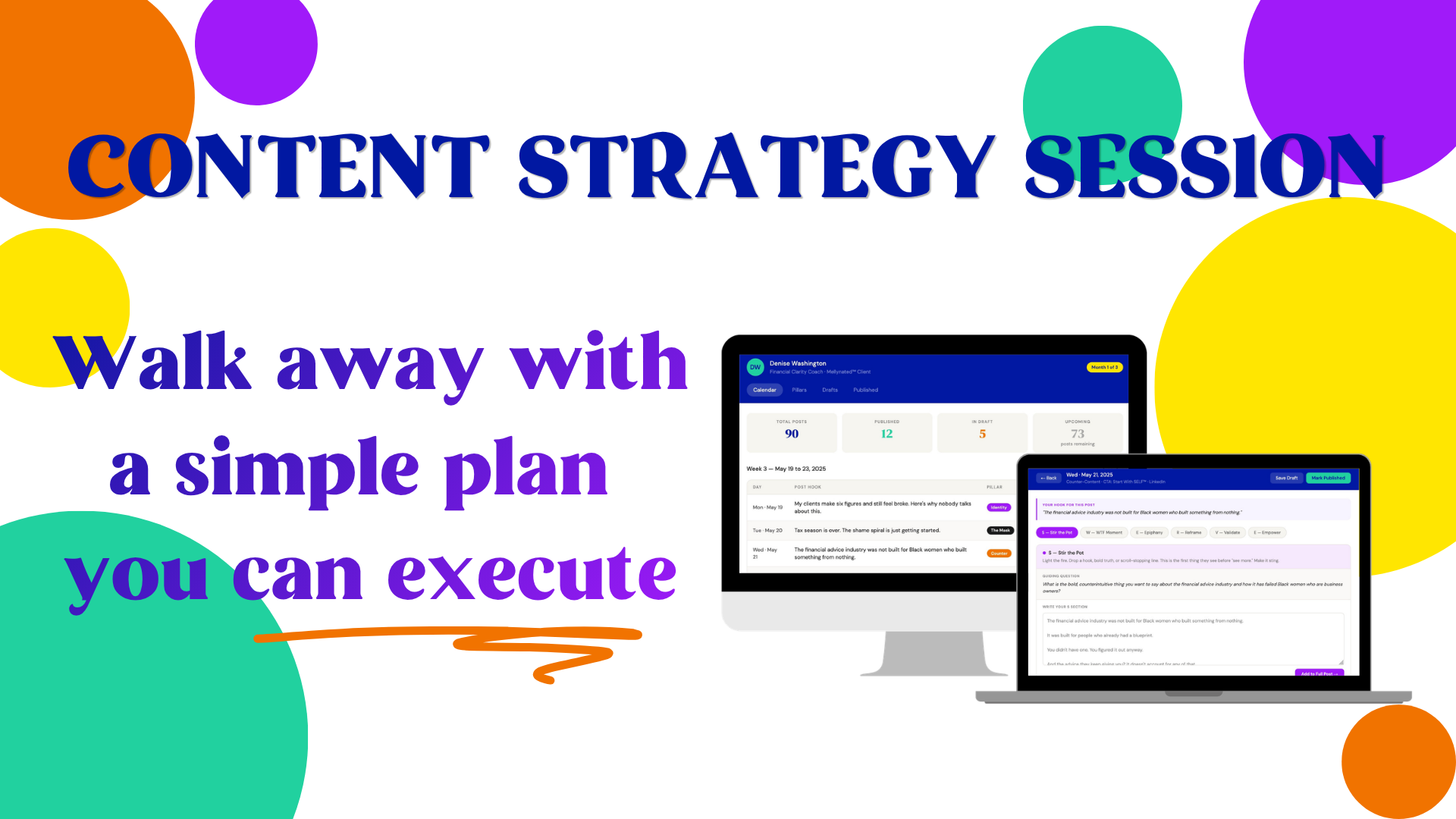
After your session, you get access to a personalized 90-day content dashboard showing you:
What to post
Where to post it
When to post it
What each piece of content is supposed to accomplish
And it's built around your voice, your expertise and your actual brand.
You can write directly inside the dashboard using the built-in SWERVE™ framework and keep everything in one place.
Book Your Content Strategy Session →
Frequently Asked Questions
What is the 4Cs of Content System™?
The 4Cs are Connection, Credibility, Change and Conversion.
They're the four jobs your content can do.
Connection helps people feel like they know you. Credibility demonstrates your expertise. Change shifts how your audience thinks. Conversion helps move them toward your offer.
How many posts do I need for a 90-day content plan?
Three posts a week for 12 weeks gives you 36 pieces of content.
That's a realistic quarterly rhythm for many service providers, especially if you're creating the content yourself.
It's also the volume behind Latricia Friend's 90-day campaign, which resulted in 500 new LinkedIn connections and a 1,000% increase in engagement.
How long does it take to plan 90 days of content?
About 2 hours is a reasonable starting point if you brainstorm one C at a time and then organize your ideas into a sequence.
The point isn't to write all 36 posts in 2 hours. You're making the decisions in those two hours. The writing happens afterward.
Can I use the 4Cs on any platform?
Absolutely. The 4Cs aren't tied to one platform because they're based on the job the content is doing, not where you publish it. You can use them for:
LinkedIn posts
Emails
Podcast episodes
YouTube videos
Newsletters
Blog posts
Social media content