Why Your Stories Are Your Strongest Marketing Tool
The Post That Filled My DMs
A few years back I shared a client win on LinkedIn.
She had come to me after being out of work for months because of the pandemic. She was barely getting callbacks and her confidence was taking hits. She enrolled in my program, we honed in on her personal brand and her unique value, I revamped her resume, optimized her LinkedIn, and gave her a real job search strategy.
Three months later she sent me an email that said the hiring manager called that morning and wanted to bring her in at six figures. She got a $23K salary increase!
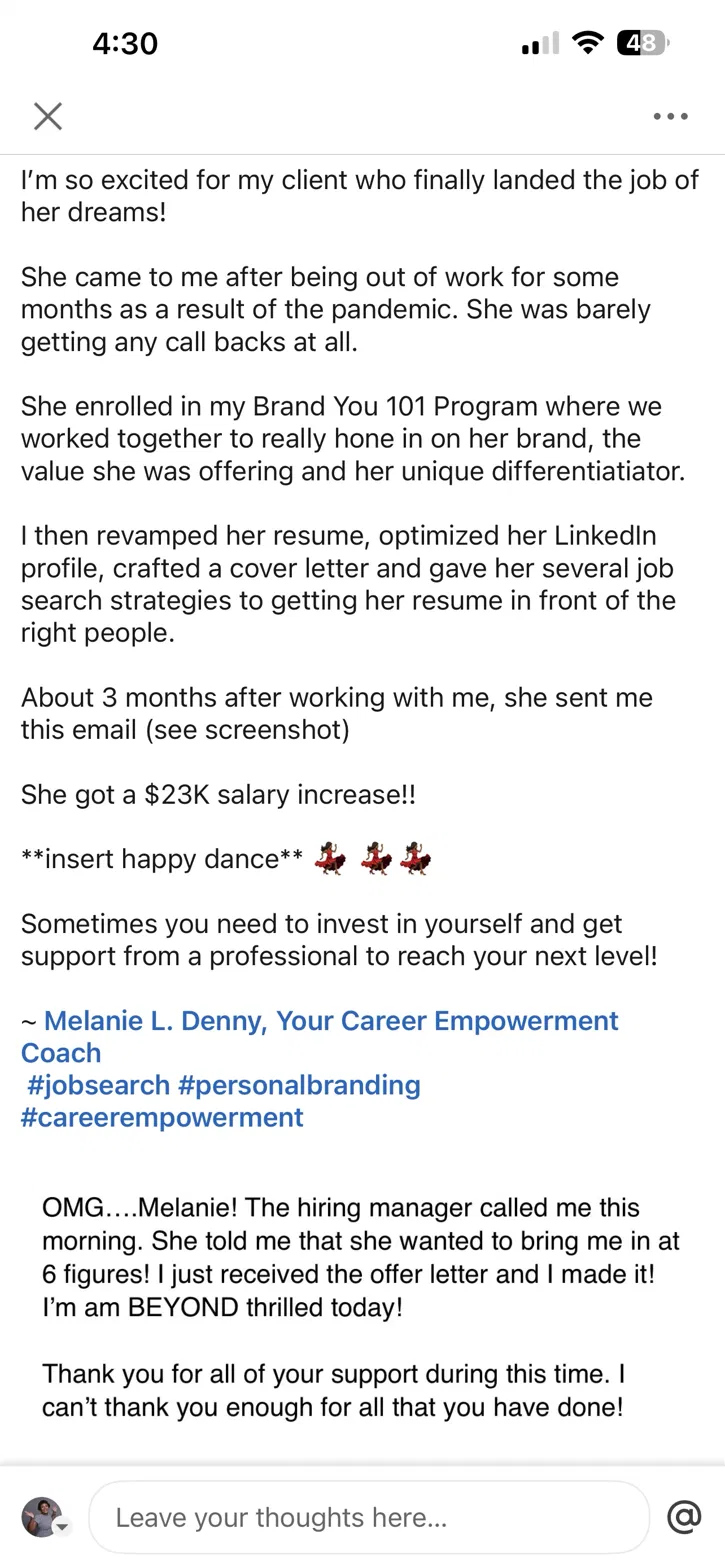
I posted that story with a screenshot of her email. And my DMs lit up.
People wanted to know if I could do the same for them. I got several leads from a single post.
And here's the thing... that happened every single time I told a client story.
Yes, I posted tips and tricks, but whenever I told stories, people reached out ready to buy.
That pattern taught me something I now teach every client. Your stories will out-market everything else you're doing.
Let me show you why.
Why Stories Beat Everything Else at Building Your Personal Brand
Think about all the marketing tactics you've tried or been told to try. Posting schedules, hashtag strategies, carousels, trending audio.
Every one of those can be copied by the next person in your industry. Your competitors can follow the same posting formula and even hire the same designer.
They cannot copy your stories. Periodt!

The client who went from no callbacks to a $23K increase was MY client who used MY process. Nobody else can tell that story.
When you're building your personal brand, your stories are the only asset that's exclusively yours.
And they work everywhere. Stories work on your website, in your LinkedIn about section, on a podcast interview, in your speaker intro, and on a sales call.
Hell, you can tell one story a dozen different ways...doesn't matter how you slice and dice it, the story still hit.
It's Not Just Me, It's Science
I could sit here and tell you my client stories work because I'm just that good. But there's actual research behind why this hits the way it does.
When somebody hears a list of facts, their brain processes language and that's about it. But when those same facts show up inside a story, multiple regions fire at once. The brain responds like you're living the thing instead of just hearing about it.
That's why stories stick...especially emotional ones.
Cognitive psychologist Jerome Bruner found the human mind is 22 times more likely to remember a fact when that fact is wrapped in a story.
Twenty-two times!
Stanford professor Chip Heath proved it in a room full of students. He had them give one-minute speeches on non-violent crime. Most loaded up on data, giving 2 or 3 statistics per speech. Only 1 out of 10 told a story.
Ten minutes later he polled the room. 63% remembered the stories and only 5% could remember a single statistic.
The London Business School did a similar study which found that people retain 5% to 10% of information when it's statistics alone. Wrap it in a story and retention jumps to 65% to 70%.
So when I posted about my client's $23K increase, I never said "book my program." I just told what happened. But that story was doing work no pitch could touch. People saw the transformation, felt it, and thought "I want that too." Then they came to me.
Proof wins every time.
When you tell a story that hits, it becomes emotional and studies also show that we make buying decisions based on emotions.
In other words, your stories do the selling without selling.
Your Client Stories Might Be Even Stronger Than Yours
Your own story matters, but your client stories often convert better.
The reason is simple. Your audience doesn't want to become you. They want to become the version of themselves that your client became. If you can help someone else similar to them, surely you can help them too, right?

When your ideal client reads about someone who was stuck exactly where she's stuck, and watched her come out the other side, she puts herself in that story automatically. The client's before is her right now. The client's after is what she's been praying on. You didn't have to convince her of anything. The story did the math for her.
So if you've been sitting on client wins because you didn't want to seem braggadocious, hear me clearly. Sharing your client's transformation is generosity, boo.
You're showing your audience what's possible for them. And you're letting your work speak in the most credible voice there is...the voice of someone who invested in your service and got the transformation they were looking for.
Just get permission first, and share the real details. The specific numbers, the specific timeline, the specific struggle…specificity is what makes it believable.
Your Personal Brand Needs a Story System
Now let's get practical, because one good story is a start but a story system is a strategy.
Here's how I structure it with my clients.
Your main story. This is the story of how you got here doing this work. The real version, with the emotion still in it. The moment things shifted, the struggle that shaped your approach, the reason this work matters to you beyond a paycheck. This story lives on your website, your about section, your speaker bio, and it gets told again and again. Repetition is a feature here, not a flaw. People need to hear it multiple times before it sticks.
Your ancillary stories. These are the situation-based stories you pull out depending on what you're trying to do. Client win stories when you need proof. Struggle stories when you want connection. Lesson stories when you're teaching. Behind-the-scenes stories when you want people to see how you work. You match the story to the moment.
Together they cover everything developing your personal brand requires. Credibility, connection, and conversion, all running on stories only you can tell.
If you want the full breakdown on how to actually structure and tell these stories, I wrote a whole piece on my SWERVE™ storytelling framework and how to pick the right story for the right moment. Read that one next.
We Been Telling Stories Forever (literally)
As Black women, we are NOT new to the art of storytelling. It's in our bones.
Before content calendars and marketing funnels, there were griots, West African storytellers who held the history of an entire community in their memory. Griots advised kings and settled disputes because they knew whoever held the story held the culture.
That tradition traveled with us across the Atlantic Ocean and it survived the people trying to legislate it out of us, back when teaching us to read was a crime. You can ban books, but you can't ban a story somebody's already carrying in their mouth.
So we kept the stories. In spirituals that carried an underlying meaning, in folktales, on the pulpit, at the kitchen table, in the salon chair, at the cookout...wherever we gather, I guarantee there's a story being told.
So when I tell you to use stories to market yourself, don't stress...just do what you already know how to do without thinking.
Start Collecting Your Receipts
Alright, here's your homework...
Open a note on your phone and title it Story Bank. Then start listing. The moment you knew this was your work. The client whose results still make you smile. The failure that taught you the thing you now teach. The email or text a client sent you that you never shared.
You already have the stories. They're sitting in your camera roll, your inbox, and your memory. Just marketing gold, collecting dust.
But collecting them is the easy part. The hard part is knowing which story to tell, when to tell it, and how to turn all of it into content you'll actually post. That's what most people get stuck on. The stories stay in the note and never make it to the feed.
That's exactly what we do together in a Content Strategy Session.
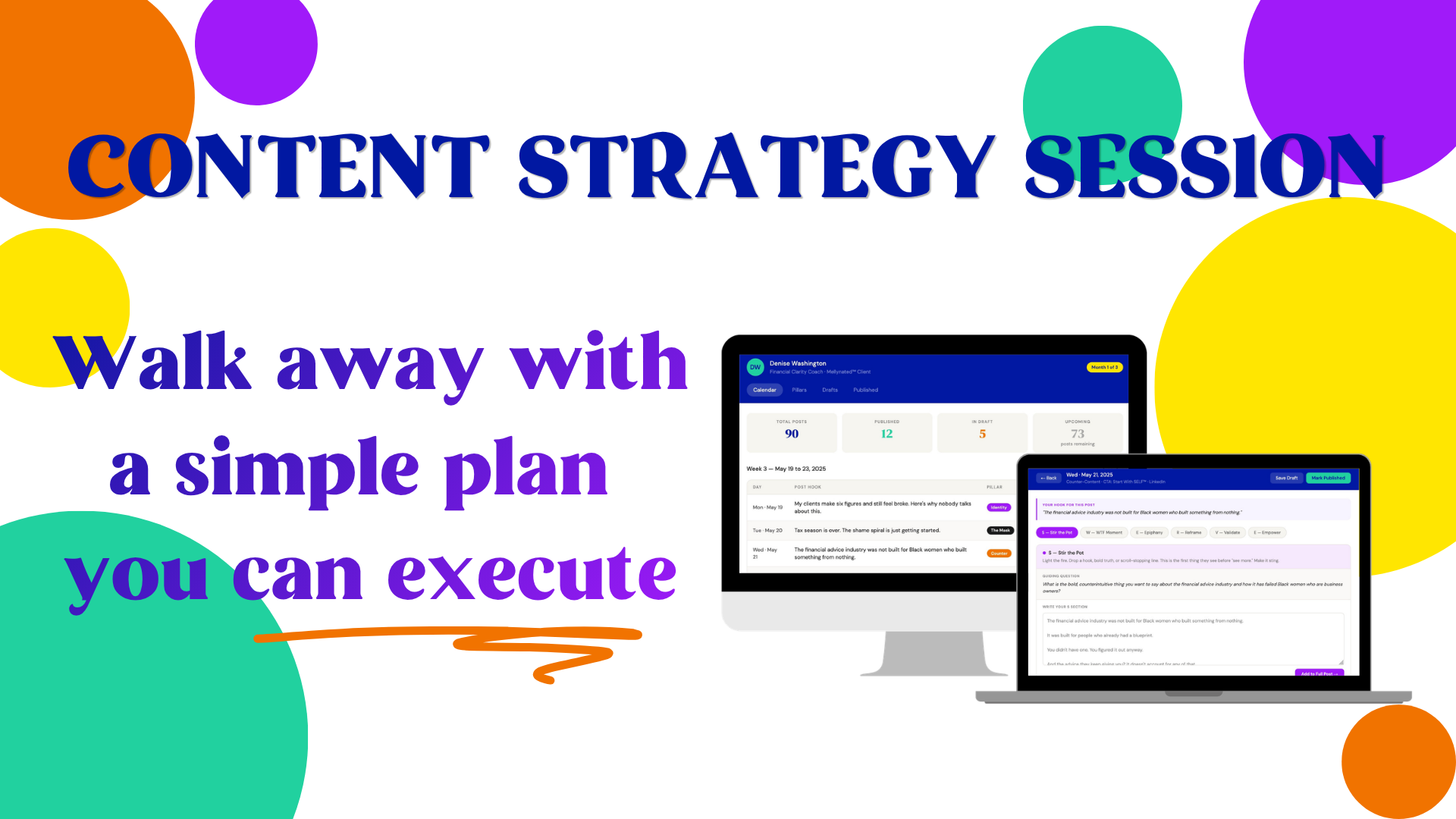
We pull your real stories out, match them to what you're teaching and selling, and map them across 90 days of content using my 4Cs of Content System™ and the SWERVE™ storytelling framework. You walk away with a personalized dashboard that tells you what to post and when, so you're never staring at a blank screen wondering which story to tell. Your stories, organized and scheduled, working for you instead of sitting in your phone.
If you've got the receipts but no plan for them, this is the solution you need.
Book Your Content Strategy Session → mellynated.com/content-strategy