How to Tell Your Brand Story in a Way That Actually Connects
I Wrote a Calypso Song About Grapes
Yep...sure did.
I've been a writer my whole life. As a kid I was the one with my head in a book, filling up notebooks with poems, essays, and stories. By 13 I was writing stories my friends would pass around and actually beg me to finish. I wrote about everything.
Including a whole calypso song about grapes.
Don't ask. The song was a hit tho.
What I didn't know back then was that I was building the exact skill that would carry my entire career.
When I started writing resumes in 2009, I thought I was just helping people organize their work history. But what I was really doing was telling stories.

I took careers that looked scattered on paper and shaped them into narratives that made hiring managers lean in. I coached my clients to stop reciting their job duties in interviews and start telling stories about what they actually did. And those clients kept landing 6-figure roles.
It wasn't until I got deep into personal branding that I learned why it all worked so well.
Storytelling is brain science.
Emotional stories light up 5+ regions of the brain at once. When you hear a list of facts, your brain processes language and that's about it. But when those same facts come wrapped in a story, your brain responds like you're living it.
According to cognitive psychologist Jerome Bruner, the human mind is about 22X more likely to remember facts when those facts are part of a story.
Stanford professor Chip Heath proved this in real time. He had students give one-minute speeches on non-violent crime. Most students loaded up on data, about 2.5 statistics per speech. Only 1 in 10 told a story. Ten minutes later he polled the room. 63% of students remembered the stories. Only 5% could remember a single statistic.
The London School of Business found the same thing. People retain 5% to 10% of information when it's statistics alone. Wrap it in a story and retention jumps to 65% to 70%.
So when it comes to building your personal brand, this is not a cute little nice-to-have. Your stories are doing the heavy lifting in whether people remember you, trust you, and eventually buy from you.
The problem is most people have no idea which stories to tell or how to tell them.
This article will help you with that.
Why Brand Storytelling Works When Everything Else Falls Flat
Think about the content you actually remember.
I'd bet money it wasn't a carousel of tips. It was somebody's story. The post about the client who almost gave up. The video where she talked about getting laid off and starting over. The caption about crying in the car after that meeting.
That's brand storytelling doing what only it can do.
Tips are easy to scroll past because everybody got tips.

But nobody else has your story; it's the one piece of content your competitors literally cannot replicate. It's your built-in differentiator.
And for us as Black women, this matters even more.
So many of us were taught to keep our business to ourselves.
Don't let folks know your struggles.
Show up polished or don't show up at all.
So we post the tips and the frameworks and the credentials, and we keep the human parts tucked away.
Then we wonder why our content gets respect but no real connection and people comment "great post" but never reach out.
Your audience doesn't connect with your polish, boo. They connect with your story.
How to Tell Your Brand Story Using the SWERVE™ Framework
After years of telling stories for clients and watching what actually moves people, I built the SWERVE™ storytelling framework. It's the structure I use in my own content and the one I teach inside my Content Strategy Sessions.
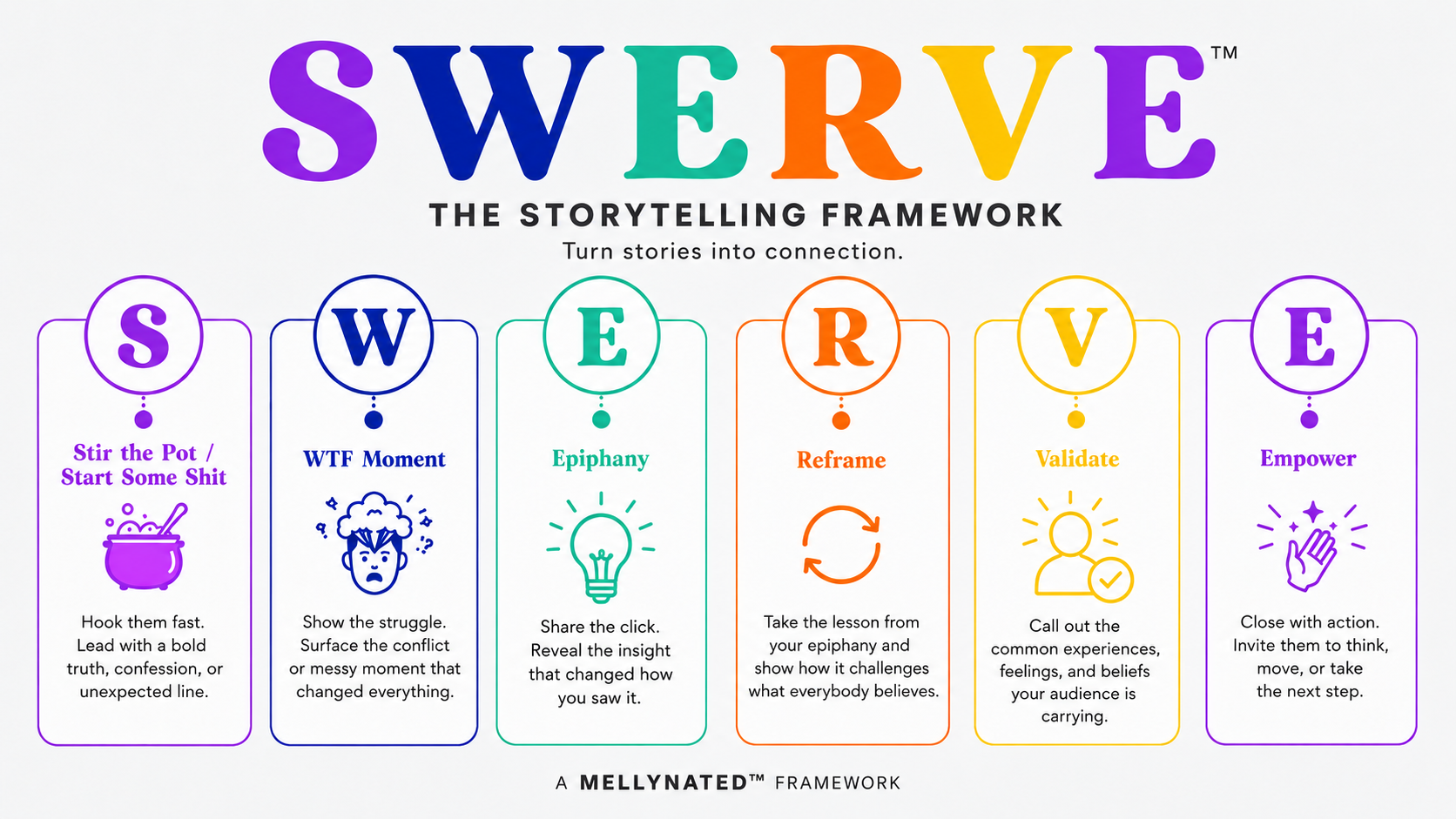
Here's how it works, letter by letter.
S — Stir the Pot / Start Some Shit
Open with something that interrupts the scroll. A bold statement, a confession, a line that makes them stop and say wait, what?
Hooks like, "I am a fraud" stirs the pot. So does "I fired my biggest client last month" or "I ran a business I hated for 13+ years."
You're not being dramatic for attention. You're earning the right to be heard in a feed full of noise.
W — WTF Moment
This is the struggle, the conflict, the moment things went left. The layoff, the failure, the client from hell, the moment you realized something had to change.
This is the part most of us want to skip because it's vulnerable. But the WTF moment is where your audience starts seeing themselves in your story.
E — Epiphany
What clicked? What did you realize in the middle of the mess that changed how you saw everything?
For me, it was realizing the storytelling I'd been doing since I was 13 was the exact reason my resume clients kept winning. The thing I thought was just a hobby was actually my superpower.
R — Reframe
Now shift the perspective. Take the lesson from your epiphany and show how it challenges what everybody believes.
This is where you drop the take that goes against the norm. The industry says post more, you learned that clarity beats volume. Everybody says stay professional, you learned that personality is what converts. The reframe the thing you now know that most people, experts, or society get wrong.
V — Validate
Now turn to your reader directly and let them know they're not alone in this.
This is where you call out the common experiences, feelings, and beliefs your audience is carrying. The fear they haven't said out loud, the frustration they think is just them, call it out.
Quick example, "If you've ever written a post and deleted it before publishing, I see you." That's validation. You're telling them their experience is real, it's common, and it makes sense.
This is the moment your story stops being about you and becomes about them. They went on the journey with you, and now you're showing them you understand theirs.
E — Empower
Close by calling them to something. Think differently, take an action, grab a resource, book a call. Your story moved them. Now give that movement somewhere to go.
That's SWERVE™. This framework that take someone from scrolling past you to feeling like they know you.
How to Pick the Stories That Actually Connect
Now here's where most people get stuck. They understand storytelling matters but they're telling the wrong stories.
The secret to a personal brand story that connects is that it's not really about you. It's about them. You pick your stories based on knowing your audience, what they're going through, what they're afraid of, and what they're trying to become.
Before you tell any story, run it through these three Rs. Can they relate to it? Does it resonate emotionally? Is it relevant to where they are right now?
Then use my 4Cs of Content System™ to choose which story to tell.
Every piece of content you create should be doing one of four jobs, connecting, building credibility, changing perspective, or converting. And each of those jobs calls for a different type of story.
CONNECTION — Stories That Make Them Feel Seen
This is where your personal challenges, aha moments, lessons learned, and behind the scenes content lives.
These are the stories from your real life that make your audience think "she gets me." The key is picking moments where YOUR experience mirrors THEIRS. You're not sharing for the sake of sharing. You're sharing because your story is their story too.
Ask yourself:
What was the moment everything shifted for me? Where was I, what was I doing, what triggered it?
What's a behind the scenes reality of my work that my audience would be surprised to learn?
What lesson did I learn the hard way that my ideal client is still learning right now?
CREDIBILITY — Stories That Prove You Know Your Shit
This is where your tips, facts and stats, proven frameworks, industry secrets, FAQs, and industry commentary live.
Most people deliver this content as straight information. But remember those retention stats from earlier. Wrap your expertise inside a story and your audience actually keeps it. Instead of listing tips, tell the story of how you discovered the tip. Instead of dropping stats, show why the stat matters through a real client scenario.
This is also where you weigh in on what's happening in your industry right now. When a big name drops a book or a hot take starts trending and you have a perspective on it, share it. You're showing your audience you're not just in the conversation, you're shaping it.
Ask yourself:
What result did I help a client achieve that I'm genuinely proud of? What was their before and after?
What's something most people in my industry get wrong that I've figured out through experience?
What's happening in my industry right now that I have a real opinion about?
CHANGE — Stories That Shift How They Think
This is where your new perspectives, mindset shifts, motivation, and unpopular opinions live.
These are the stories where you overcame something your audience is currently battling. When you share what you pushed through, you position yourself as the one who gets it AND got through it.
Your failure stories live here too. They feel risky to tell, but they do something your wins can't. They make you human. They show your audience that stumbling is part of the journey and you can still make it happen.
Ask yourself:
What did I have to overcome to get where I am now? And what version of that struggle is my audience living right now?
What's an unpopular opinion I hold about my industry that I know from experience is true?
What failure taught me something my audience needs to hear?
CONVERSION — Stories That Move Them to Act
This is where your social proof, work samples, offer benefits, and differentiation live.
These are your client stories and transformation stories. The ones that show your audience what's possible when they say yes.
Don't just list what you offer. Tell the story of what happened when somebody invested. Paint the before, walk them through the shift, and let the after speak for itself.
Ask yourself:
Which client came to me stuck, and what shifted for them after we worked together?
What does life actually look like for my clients after working with me?
Why does my approach work when everything else my audience tried didn't?
One story, told well, can do more than one of these jobs at once.
That's why storytelling for business is the most efficient content strategy there is. You're not choosing between being relatable and being strategic. The story does both.
This is exactly the work we do with clients in the Content Strategy Session.
We dig into your real stories, map them to your audience using the 4Cs, structure them with SWERVE™, and build out 90 days of story-driven content that sounds like you because it came from you.
And you don't walk away with just notes and good vibes. You get a personalized content dashboard that maps out exactly what to post, where to post it, and when for the full 90 days.
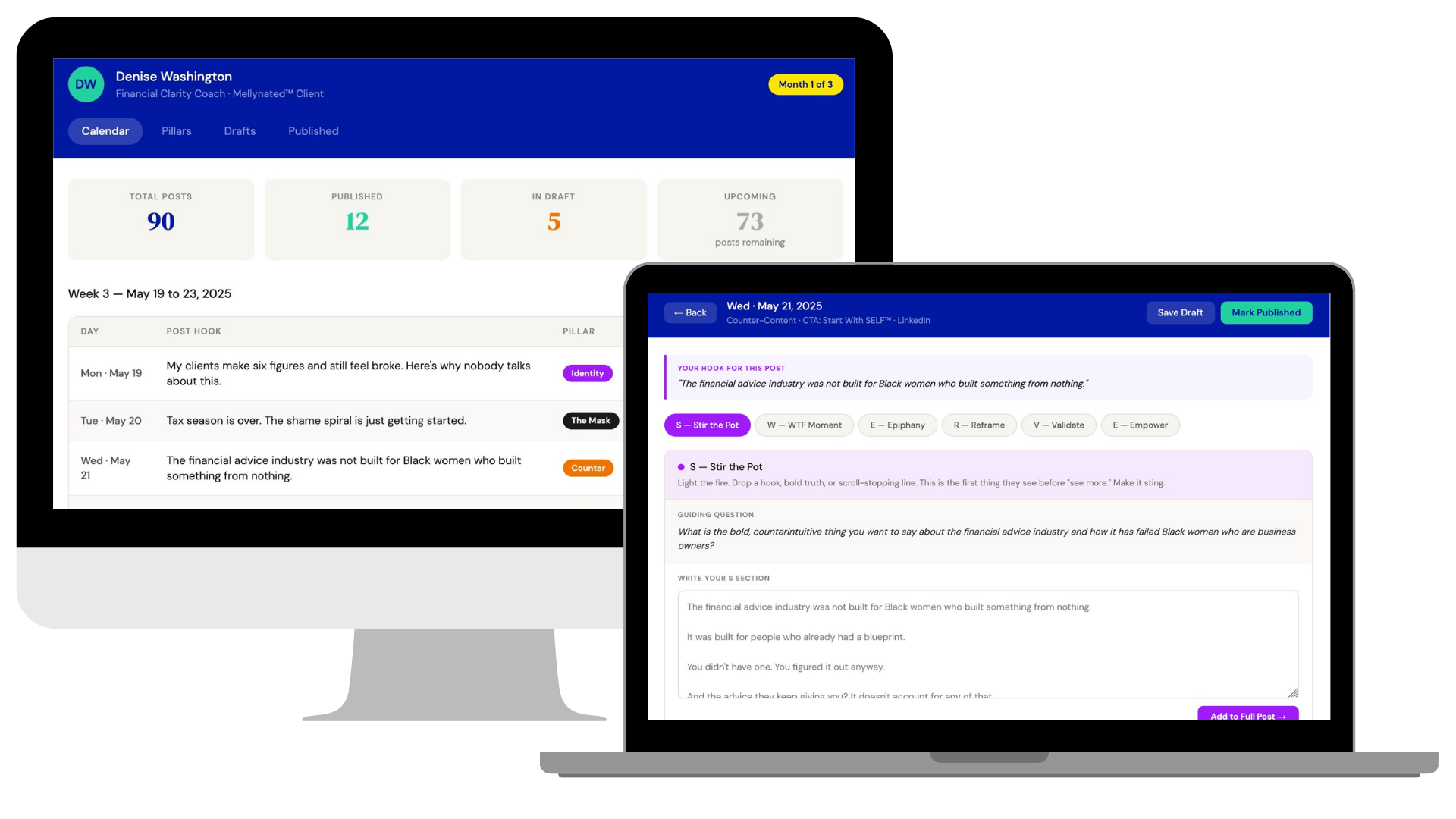
Every post pre-planned around your real voice, your real expertise, and your real stories. You can even write your posts directly inside the dashboard using the built-in SWERVE™ framework.
If you've been sitting on your stories because you didn't know which ones to tell or how to tell them, the Content Strategy Session was built for you.
Start With One Story
You don't need a content overhaul to start using brand storytelling. You need one story, told with intention.
So here's your homework. Think about one moment that changed how you move. Run it through the three Rs. Structure it with SWERVE™. Post it this week.
Then watch what happens. Because I promise you, the post with your real story in it will outperform the prettiest infographic you ever made.
And if you want to know whether your overall brand is set up for your stories to actually convert, that's what the Digital Brand Audit is for. We look at your messaging, your visibility, your credibility, all six areas of the Surface Check™, and get honest about what's working and what's not.