
Your Personal Brand Authority Sets Your Price (Here's How to Raise Both)
Somebody Called Me the Wal-Mart of the Resume World
About 5 years into my resume business, someone in the industry told me I was the Wal-Mart of the resume world.

She wasn't wrong.
I started out charging $35 for a resume. And listen, people STILL complained. They haggled over $35 like I was asking for a kidney. Selling was hard, clients were difficult, and I was grinding for chump change.
Over time I went to $75. Then $150. Then $400 packages with the resume, cover letter, and LinkedIn. By the end, I was charging a minimum of $1,000 for a resume alone and $3,500 for packages.
Same girl. Same service. What changed?
The authority behind the price.
By then I had been quoted and featured in Forbes and 30+ other outlets. I'd been nominated for resume writing awards 4 times. I had receipts stacked on receipts.
And I had finally looked around at the market, compared my work to what others were charging, and realized I'd been playing in the clearance aisle when my work belonged in the upscale boutique.
Wal-Mart is a business model that works, don't get me wrong. But I didn't want to appeal to any and everybody. I wanted the clients who valued my work, paid without drama, and let me serve them at my highest level.
If you're reading this and you know deep down you're undercharging, this post is for you.
And real talk, your brand might be the reason. Before anybody reads your About page or books a call, your price is already talking. A bullshit price screams "I'm not sure about me either," and the market hears that loud and clear.
So if you've been wondering why people haggle you down or treat your work like it's optional, your price tag might be telling on you.
Let's talk about how to price your services so the number finally matches the work.
What People Are Actually Paying For
People aren't paying for your time or your deliverables. They're really just paying for 3 things.
The outcome you're promising.
This is the biggest one. When I was writing resumes, I wasn't selling a document. No one cared about that. I was selling a $15K to $50K salary increase. And my clients were getting them. So when I quoted $3,500, that was a drop in the bucket compared to what they'd make back in the first 2 months of the new job. I believed that with my whole chest, and it showed in how I sold.
So ask yourself, what is the real outcome of your work? Not the deliverable. The transformation. When you price against the outcome instead of the hours, the math changes completely.
The results your clients actually get.
Outcomes you promise mean nothing without proof you deliver them. Client wins, testimonials, case studies, transformations people can see. Every result you can point to is a reason your price makes sense.
Your perceived authority in the marketplace.
This is where your personal brand does the heavy lifting. Media features, podcast interviews, speaking gigs, awards, a body of content that shows you know your stuff.
When someone Googles you and finds all that, the price conversation changes before it even starts. People will pay when they believe you know what you're doing, and they'll pay even more when you clearly specialize in their exact situation.
This is your brand doing the selling before you ever get on a call. When your authority is visible, the price stops being a debate. I broke that down here.
Quality of work matters, obviously. But quality alone never raised anybody's prices. I was good at $35. The market just didn't know it yet.
Why We Come in Charging Bullshit
Now let me talk to my Black women for a minute, because I've seen this pattern up close.
When I was mentoring resume writers, I noticed something that I didn't like. The white women came into the industry and priced themselves at the middle or top of the market from day one. The Black women came in charging bullshit. $25 resumes. $50 packages. Pricing that guaranteed they'd stay broke and burnt out.
There are a few reasons why we did that.
We typically don't know people who spend like that.
A lot of us didn't grow up around folks with four-figure budgets for personal development. I sure didn't. So when we set prices, we price for the people we know, and the people we know are looking for a deal. But your pricing shouldn't be based on what your cousin would pay. It should be based on what your ideal client, the one with the problem you solve, would happily invest to fix it.
We don't feel deserving of it.
This is the one that had me stuck for years. I hated asking for anything. Asking felt greedy, like I was taking instead of earning, even when I had more than earned it. We tend to give and give, help everybody, pour into people who never even say thank you. Charging real money for real work makes us selfish or even greedy.
It doesn't. That mindset is damaging, and it's keeping you broke. You are allowed to be paid well for work that changes people's lives. Wanting to be compensated fairly is not greed. Making a healthy profit is the whole point of running a damn business.
We've been conditioned not to ask for a lot.
This is the deep one. We second-guess ourselves into the ground. Other people can charge that, but not us, because of every excuse in the book about why we don't deserve it and we call it being humble when really it's a result of conditioning.
We've been underpaid for the same work our whole careers. Entrepreneurship didn't suddenly erase that...we brought it with us straight from corporate.
Look, your pricing is a positioning statement. When you charge bullshit, the market believes that you are also in fact, bullshit.
And we both know you're not. You are twice as good and if you're anything like the clients I attract, your halfass is wayyy better than your competitor's 100% effort on any day.
How to Price Your Services: Do the Math First
When I ran my group of resume writers, my main message was simple. Raise your prices. And when the emotions got in the way, I made them do the math.
Take your revenue goal for the month. Now look at your actual capacity, meaning how many clients you can serve well without running yourself into the ground.
Say you want to make $10K a month and you can realistically handle 8 clients. That's $1,250 per client, minimum. That's what your price needs to be for your goal to even be possible.
Now run the math on your current prices. If you're charging $300, you'd need 34 clients a month to hit that same goal.
Thirty-four!
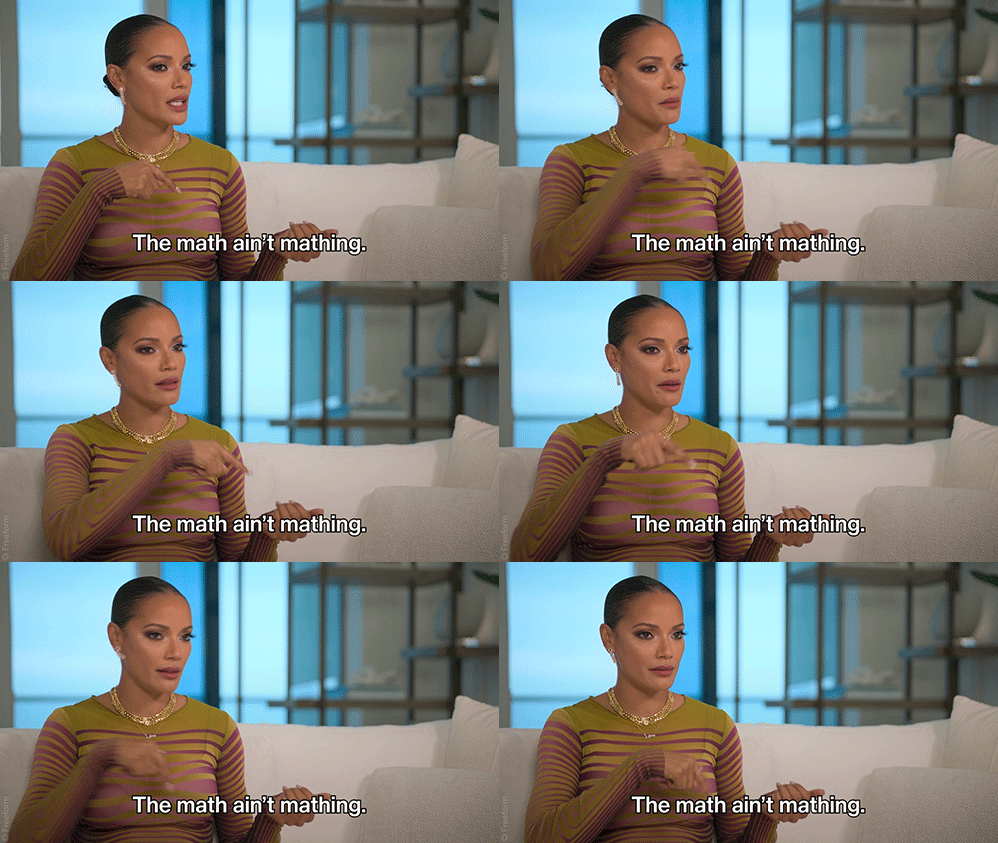
Can you deliver excellent work to 34 people a month? Can you even FIND 34 clients a month? No ma'am. That's giving burnout city.
And if revenue goals feel too abstract, here's a simpler test. Take one recent project and count the REAL hours. Not just the deliverable. The calls, the revisions, the emails, the "quick questions" that weren't quick. Now divide what you charged by those hours.
That $300 package that took you 15 hours? You made $20 an hour with expert-level skills. Chile, the temp agency pays more than that, and they don't need you to have a framework.
Undercharging doesn't just hurt your bank account, it drains your belief in the business and your abilities. You do all this work, deliver all these results, then look at your account and can't even treat yourself.
If you're working full weeks and can't cover a massage and a nice dinner without guilt, you don't need a new strategy, boo. Raise them prices.

Your price isn't just about what you're worth. It's about what your business needs to survive and what your capacity can actually hold.
How to Actually Set Your Number
Alright, grab a pen. This part takes ten minutes.
Step 1. Find your floor. Revenue goal divided by capacity, the math we just did. You never price below this number again.
Step 2. Count your receipts. Pricing against your authority starts with knowing what a stranger can verify. Check what you've got that someone could find in five minutes of Googling you:
Client results with real numbers behind them
Testimonials or case studies posted publicly
Media features, podcast interviews, or speaking gigs
A named framework or process that's yours
A clear specialty, meaning you're known for one thing, not everything
A body of content that shows how you think
Step 3. Let the count set your price. Zero to two checks, charge your floor and spend the next 90 days stacking receipts. Three or four, price above your floor, the proof is there to hold it. Five or six, and I need you to hear this, you are underpriced right now. Go look at what the top of your market charges, because that's your lane, and the only thing keeping you out of it is that conditioning we just talked about.
Step 4. Price against the transformation. Hold your number up next to what your work actually produces. A good benchmark is roughly 10% of the outcome you create. So if your work lands someone a $30K raise, a $3K price is reasonable and easy to defend.
Now look at what a lot of us are actually charging. $1,500 for that same $30K result is a 20x return for the client. You're not selling a service at that point, you're handing out a come-up.

Not every outcome comes with a dollar sign. If what you deliver is confidence, clarity, peace of mind, or hours back in someone's week, the 10% math gets fuzzier, and that's where your authority does even more of the work. The stronger your brand and your receipts, the less you need a tidy number to justify the price.
Charge at least the 10% when the outcome has a number. Then let your authority carry it higher.
And next year, raise it again. Your receipts will have grown. Your price should too.
What Happened When My Client Raised Her Prices
Let me give you proof this works.
My client came to me as an established career coach with real expertise. We did her branding, built out her positioning, and got her content working for her. And then I told her to raise her prices.
She did.
And after our content started positioning her as the expert she already was, she landed her highest-paying client ever.
Notice the order there...
The expertise was always there. The branding made the expertise visible, the visibility built the authority, and the authority held the price. Her new client didn't negotiate, because everything they found when they looked her up said she was worth it.
That's the sequence. Authority first, then price, then the clients who pay it.
Your Brand Has to Back Up the Number
You can't just wake up tomorrow and triple your prices with a raggedy brand behind you. The price and the brand have to rise together. When someone hears your new number and goes looking, everything they find needs to say "yeah, that checks out."
That means your positioning is clear. Your receipts are visible. Your content sounds like an authority. Your presence matches the promise.
Raising your prices only works when the brand behind them holds up.

If you're not sure your brand can hold a higher price yet, start with the 6 Must-Haves for Your Personal Brand. It breaks down exactly what needs to be in place to position yourself as the one worth paying for.
Grab Your Free Guide → mellynated.com/6-must-haves-for-your-personal-brand